

How to Build a Data Science Portfolio with Zero Work Experience
Starting a career in data science without experience feels like a dead end. It’s not. The real problem is not lack of experience — it’s lack of proof. Companies don’t hire based on what you know, they hire based on what you can show. Your portfolio is that proof.
If you don’t build one, you stay invisible.
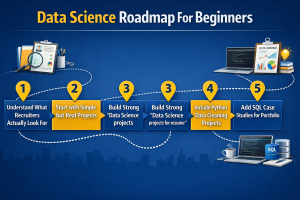
1. Understand What Recruiters Actually Look For
Stop assuming recruiters want certificates. They don’t care much. They want evidence of skills:
- Can you clean messy data?
- Can you find insights?
- Can you explain results clearly?
Your portfolio must answer these questions. If it doesn’t, it’s useless.
2. Start with Simple but Real Projects
Don’t try to build complex AI models on day one. That’s a mistake beginners make.
Start with:
- Basic analysis projects
- Real-world datasets (Kaggle, government data)
- Clear problem statements
Examples of strong beginner projects:
- Sales data analysis
- Customer churn analysis
- Social media trends
Focus on clarity over complexity.
3. Build Strong “Data Science projects for resume”
This is where most people fail — they build random projects with no structure.
Each project in your portfolio must include:
- Problem statement
- Dataset explanation
- Data cleaning steps
- Analysis
- Insights
- Conclusion
If any of these is missing, your project looks incomplete.
Good Data Science projects for resume are not about showing code — they are about showing thinking.
4. Include Python Data Cleaning Projects
Raw data is messy. Companies know that. That’s why cleaning skills are highly valuable.
Create at least 2–3 Python data cleaning projects:
- Handling missing values
- Removing duplicates
- Formatting inconsistent data
- Working with CSV/Excel files
Use libraries like:
- Pandas
- NumPy
Don’t just clean data — explain why you made each decision. That’s what makes your work stand out.
5. Add SQL Case Studies for Portfolio
If you skip SQL, you’re limiting yourself.
Most real-world data jobs require database work. So include SQL case studies for portfolio such as:
- Querying sales databases
- Customer segmentation
- Revenue analysis
Show:
- Joins
- Group by
- Aggregations
- Subqueries
Avoid basic queries only. Add at least one case study that solves a business problem.
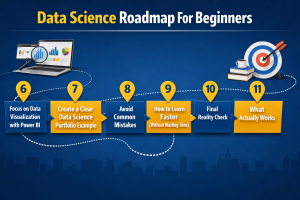
6. Focus on Data Visualization with Power BI
If your insights are not clear, they are useless.
That’s why Data visualization with Power BI is critical.
Create dashboards like:
- Sales performance dashboard
- Marketing campaign dashboard
- Financial analysis dashboard
Make sure your dashboard:
- Is clean and simple
- Uses proper charts (not random visuals)
- Tells a story
Bad dashboards confuse. Good dashboards convince.
7. Create a Clear Data Science Portfolio Example
Don’t just upload random files. Structure matters.
A strong Data Science Portfolio example includes:
- 4–6 well-documented projects
- GitHub repository
- Short descriptions for each project
- Clean code and comments
Optional but powerful:
- Personal website
- LinkedIn project showcase
Your portfolio should look organized. If it looks messy, recruiters assume your thinking is messy too.
8. Avoid Common Mistakes
Let’s be direct — most beginner portfolios fail because of these mistakes:
- Copying projects from YouTube
- No explanation, only code
- Too many small, weak projects
- No real-world problem solving
- Poor presentation
If your portfolio looks like everyone else’s, you won’t get noticed.
9. How to Learn Faster (Without Wasting Time)
Learning alone is slow and confusing. You need structure.
This is where institutes like Innozant Institute help.
Instead of guessing what to learn, you get:
- Guided projects
- Real-world case studies
- Mentorship
- Industry-relevant skills
That reduces trial and error and helps you build a job-ready portfolio faster.
10. Final Reality Check
Let’s stress-test this idea:
Assumption:
“Building a portfolio will get me a job.”
→ Wrong. A good portfolio gives you a chance.
Risks:
- Spending months on low-quality projects
- Learning tools without understanding concepts
- No consistency
Failure Mode:
You build projects → No interviews → You quit.
Why this happens:
Because your portfolio doesn’t show value.
11. What Actually Works
If you want results, follow this minimum plan:
- 2 Python data cleaning projects
- 2 analysis projects
- 1 Power BI dashboard
- 1 SQL case study
That’s it. Not 20 projects. Just 6 strong ones.
Final Thoughts
You don’t need experience to start in data science. You need proof of skill.
A strong portfolio with:
- Real projects
- Clear explanations
- Business-focused insights
…is enough to open doors.
Stop waiting for opportunities. Build evidence.
And if you want structured guidance, practical training, and faster growth, learning through places like Innozant Institute can help you avoid mistakes and build a portfolio that actually gets noticed.
Now the real question is —
Are you building something that proves your skill, or just collecting certificates?

Leave A Comment
You must be <a href="https://www.innozant.com/wp-login.php?redirect_to=https%3A%2F%2Fwww.innozant.com%2Fhow-to-build-a-data-science-portfolio%2F">logged in</a> to post a comment.