
Data Analytics vs Data Analysis – Complete 2026 Guide
In today’s data-driven world, terms like data analytics, data analysis, and data science are often used interchangeably. However, they are not the same thing. Understanding the difference between data analytics vs data analysis is important for students, professionals, and businesses looking to make better decisions using data.
This guide explains the key differences, real-world examples, career opportunities, and how these fields fit into the broader world of data science.
What Is the Difference Between Data Analytics vs Data Analysis?
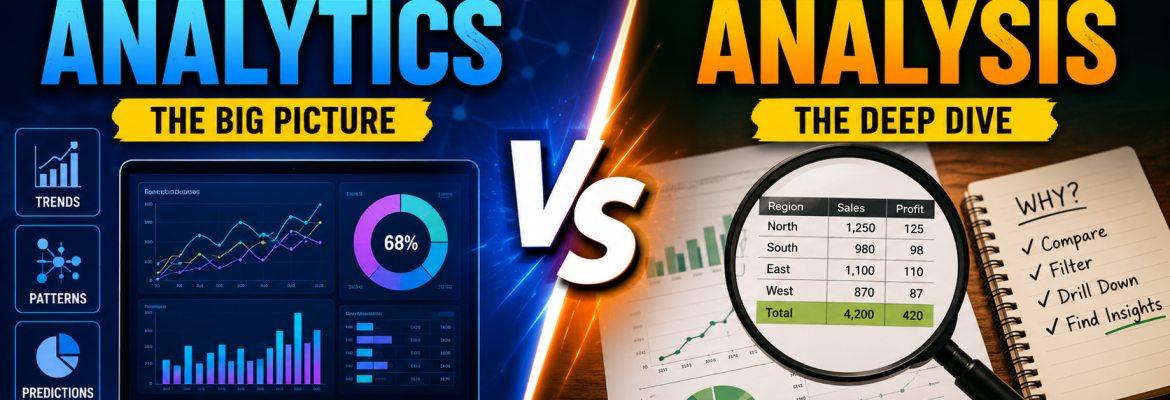
Data analysis focuses on examining data to identify patterns, trends, and insights.
Data analytics is a broader field that includes data collection, preparation, analysis, visualization, and decision-making.
In simple terms:
- Data analysis is a part of data analytics.
- Data analytics uses data analysis techniques to solve business problems.
- Data science combines analytics, statistics, programming, and machine learning to build predictive solutions.
| Feature | Data Analysis | Data Analytics |
| Purpose | Understand existing data | Generate insights and drive decisions |
| Scope | Narrow | Broad |
| Focus | Examining data | End-to-end data process |
| Output | Reports and findings | Business recommendations |
| Tools | Excel, SQL, Python | SQL, Python, Tableau, Power BI |
Understanding Data Analytics vs Data Analysis
Although both fields work with data, their objectives differ.
What Is Data Analysis?
Data analysis is the process of inspecting, cleaning, transforming, and interpreting data to discover useful information.
Common tasks include:
- Identifying trends
- Finding patterns
- Creating reports
- Evaluating performance
- Answering specific questions
Example of Data Analysis
A marketing manager wants to know why website traffic dropped last month.
A data analyst may:
- Collect website traffic data.
- Compare month-over-month performance.
- Identify declining traffic sources.
- Present findings in a report.
The goal is to explain what happened and why.
What Is Data Analytics?
Data analytics goes beyond analyzing data. It involves using data to improve business outcomes and support decision-making.
Activities include:
- Data collection
- Data cleaning
- Data analysis
- Data visualization
- Predictive modeling
- Business strategy recommendations
Example of Data Analytics
An e-commerce company wants to increase sales.
A data analytics team may:
- Analyze customer behavior.
- Predict future buying patterns.
- Recommend personalized offers.
- Optimize marketing campaigns.
The goal is not only understanding what happened but also determining what should happen next.
How Data Science Fits Into the Picture
Many people confuse data science with both data analytics and data analysis.
What Is Data Science?
Data science is a multidisciplinary field that combines:
- Statistics
- Mathematics
- Programming
- Machine Learning
- Artificial Intelligence
- Data Analytics
Data scientists often build predictive models and automated systems capable of learning from data.
Relationship Between the Three Fields
Think of them as layers:
- Data Analysis → Examines data.
- Data Analytics → Uses insights to drive decisions.
- Data Science → Builds predictive and intelligent solutions.
Data science sits at the highest level and often incorporates both data analytics and data analysis.
Key Skills Required
Skills for Data Analysis
- Excel
- SQL
- Data Cleaning
- Reporting
- Statistics
- Visualization
Skills for Data Analytics
- SQL
- Python
- Power BI
- Tableau
- Business Intelligence
- Data Visualization
- Decision-Making
Skills for Data Science
- Python
- R Programming
- Machine Learning
- Deep Learning
- Statistics
- Big Data Technologies
Popular Tools Used in 2026
| Category | Common Tools |
| Data Analysis | Excel, SQL, Google Sheets |
| Data Analytics | Tableau, Power BI, Python |
| Data Science | Python, TensorFlow, PyTorch |
| Visualization | Power BI, Tableau, Looker Studio |
| Databases | MySQL, PostgreSQL, MongoDB |
Industry Statistics
The importance of data continues to grow across industries.
Key trends for 2026:
- Organizations generate over 300 million terabytes of data annually.
- Data-driven companies are significantly more likely to improve customer acquisition and retention.
- Demand for analytics professionals continues to grow across healthcare, finance, e-commerce, and technology sectors.
- Business intelligence and analytics remain among the fastest-growing technology skill areas.
These trends highlight why learning data analytics, data analysis, and data science skills is becoming increasingly valuable.
Career Opportunities
Data Analyst
Responsibilities:
- Create reports
- Analyze trends
- Build dashboards
- Support decision-making
Average skill requirements:
- Excel
- SQL
- Power BI
Data Analytics Specialist
Responsibilities:
- Business analysis
- Strategic recommendations
- KPI tracking
- Forecasting
Average skill requirements:
- SQL
- Python
- Tableau
Data Scientist
Responsibilities:
- Machine learning models
- Predictive analytics
- AI applications
- Advanced statistical analysis
Average skill requirements:
- Python
- Machine Learning
- Statistics
Which Career Path Should You Choose?
Choose Data Analysis if:
- You enjoy working with reports.
- You are new to data.
- You want a faster entry into the industry.
Choose Data Analytics if:
- You enjoy solving business problems.
- You want broader responsibilities.
- You like decision-making and strategy.
Choose Data Science if:
- You enjoy programming.
- You love mathematics and statistics.
- You want to build predictive models and AI systems.
Read Also : Skills That Can Double Your Income
Practical Learning Roadmap
Beginner Level
- Learn Excel
- Learn SQL
- Understand statistics
Intermediate Level
- Learn Python
- Create dashboards
- Practice data visualization
Advanced Level
- Learn machine learning
- Study predictive analytics
- Explore data science projects
Following this roadmap can help you move from data analysis to data analytics and eventually into data science.
Final Thoughts
Understanding data analytics vs data analysis is essential for anyone entering the modern data industry.
While data analysis focuses on examining data and identifying patterns, data analytics takes a broader approach by transforming insights into business decisions. Meanwhile, data science combines advanced analytics, programming, and machine learning to create predictive solutions.
Learn Excel for free on the Innozant YouTube Channel. From basic Excel concepts to advanced formulas, Pivot Tables, dashboards, and data analysis, the channel provides practical tutorials to help students and professionals master Excel and improve their career opportunities.
If you’re just starting, begin with data analysis fundamentals, expand into data analytics tools, and gradually develop data science skills. This approach creates a strong foundation for one of the most in-demand career paths of 2026.
FAQs Of Data Analytics vs Data Analysis
1. Is data analytics the same as data analysis?
No. Data analysis is a subset of data analytics. Analytics includes collecting, processing, analyzing, and using data for decision-making.
2. Which is better, data analytics or data analysis?
Neither is better. Data analysis is ideal for understanding data, while data analytics focuses on applying insights to business decisions.
3. Does data science include data analytics?
Yes. Data science often incorporates data analytics, statistics, programming, and machine learning.
4. Can I become a data analyst without coding?
Yes. Many entry-level data analysts start with Excel, SQL, and visualization tools before learning programming.
5. What should I learn first: data analysis, data analytics, or data science?
Start with data analysis fundamentals, then move into data analytics and eventually data science if you want advanced career opportunities.
