

Beginner Guide to SQL for Data Analytics
In today’s digital world, data is everywhere. Businesses collect huge amounts of data every day from websites, apps, sales systems, and customer interactions. But raw data alone is not useful unless someone can analyze it and find meaningful insights.
This is where data analytics comes in. Data analysts study data to understand trends, solve problems, and help companies make better decisions. One of the most important tools used by analysts is SQL.
If you are planning to start a career in data analytics, learning SQL is one of the best first steps. In this beginner guide, we will explain SQL basics for beginners, why SQL is important, and how data analysts use SQL in real work.
What is SQL?
SQL stands for Structured Query Language. It is a programming language used to communicate with databases.
A database is a system that stores large amounts of organized data. For example, a company may store customer details, product information, and sales records in a database.
SQL helps you:
- Retrieve data from a database
- Add new data
- Update existing data
- Delete unwanted data
- Organize and filter information
For example, if a company wants to see all customers who purchased a product last month, SQL can quickly find that information.
Because of this ability, SQL has become one of the most essential skills in SQL for data analysts.
Why SQL is Important in Data Analytics
Many beginners ask the same question: Why should I learn SQL for data analysis?
The simple answer is that most business data is stored in databases. Without SQL, it is difficult to access and analyze that data.
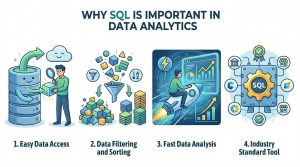
Here are some reasons why SQL is important in data analytics:
- Easy Data Access
SQL allows analysts to quickly extract the exact data they need from large databases. - Data Filtering and Sorting
Analysts can filter data based on conditions like date, location, or product type. - Fast Data Analysis
Instead of downloading huge datasets, SQL helps analyze data directly inside the database. - Industry Standard Tool
SQL is utilized by nearly all data-driven organizations.That is why it is considered a core skill in SQL for data analysts.
Because of these benefits, students who learn SQL for data analysis have better job opportunities in the data field.
SQL Basics for Beginners
If you are new to SQL, don’t worry. The basics are simple and easy to understand.The fundamental concepts are straightforward and readily comprehensible.
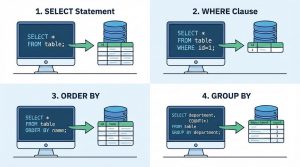
Here are some important SQL basics for beginners.
1. SELECT Statement
The SELECT command is used to retrieve data from a table.
Example:
SELECT name, age FROM customers;
This command shows the name and age of customers stored in the database.
2. WHERE Clause
The WHERE clause helps filter data based on conditions.
Example:
SELECT * FROM sales
WHERE city = ‘Delhi’;
This query shows sales data only for Delhi.
3. ORDER BY
This command sorts data in ascending or descending order.
Example:
SELECT * FROM products
ORDER BY price DESC;
This query displays products from highest price to lowest.
4. GROUP BY
The GROUP BY command helps summarize data.
Example:
SELECT city, COUNT(*)
FROM customers
GROUP BY city;
This query shows how many customers are in each city.
These are some basic concepts, but they form the foundation of SQL basics for beginners.
Read Also : How to Become a Data Analyst in 2026
How Data Analysts Use SQL in Real Work
Now let’s understand how data analysts use SQL in their daily work.
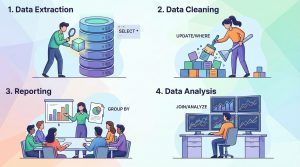
1. Data Extraction
Data analysts use SQL to extract data from multiple tables. For example, they might combine sales data with customer data to analyze buying behavior.
2. Data Cleaning
Sometimes data contains missing or incorrect values. Analysts use SQL to clean and organize the data before analysis.
3. Reporting
Many business reports are created using SQL queries. These reports help companies track performance, revenue, and customer activity.
4. Data Analysis
Analysts write SQL queries to find trends, patterns, and insights in large datasets.
For example, they may analyze:
- Which products sell the most
- Which city generates the highest revenue
- Customer purchasing patterns
This is exactly how data analysts use SQL to help businesses make better decisions.
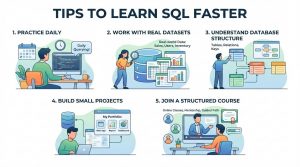
Tips to Learn SQL Faster
If you want to learn SQL for data analysis, here are some practical tips:
- Practice Daily
Writing SQL queries regularly is the best way to learn. - Work with Real Datasets
Practice with sales data, customer data, or marketing data. - Understand Database Structure
Learn how tables, rows, and columns work in databases. - Build Small Projects
Create simple projects like sales analysis or customer reports. - Join a Structured Course
A guided learning program can help you understand SQL faster with practical examples.
Learn Data Analytics with SQL at Innozant Institute
If you want to build a strong career in data analytics, learning SQL with practical training is very important.

Innozant Institute offers a beginner-friendly data analytics course with SQL designed for students and professionals who want to start their journey in the data field.
The course focuses on:
- SQL basics for beginners
- Real-world data analytics projects
- Practical database training
- Industry-relevant analytical skills
- Hands-on learning with real datasets
Students also receive career guidance and support to prepare for data analyst roles.
The training is designed in a simple way so anyone can learn SQL for data analysis even without a technical background.
Final thoughts
SQL is one of the most important skills for anyone who wants to work in data analytics. It helps analysts access, organize, and analyze large amounts of data quickly and efficiently.
By learning SQL basics for beginners, you can start understanding how databases work and how businesses use data to make decisions.
If you want to build a successful career in data analytics, now is the perfect time to start learning SQL for data analysts.
To gain practical knowledge and industry skills, consider joining the data analytics course with SQL at Innozant Institute and begin your journey toward becoming a professional data analyst.
Check our YouTube channel for free tutorials on Excel, SQL, and Data Analytics. 👉 INNOZANT

Leave A Comment
You must be <a href="https://www.innozant.com/wp-login.php?redirect_to=https%3A%2F%2Fwww.innozant.com%2Fsql-for-data-analytics%2F">logged in</a> to post a comment.