


GEO Full Form in Digital Marketing: Complete Guide
If you are learning digital marketing in 2026, you may have come across the term GEO. But what is the GEO full form in digital marketing?
GEO stands for Generative Engine Optimization. It is the process of creating and optimizing content so that AI-powered search and answer engines can understand, select, summarize, and potentially cite your content in their responses.
Unlike traditional SEO, which primarily focuses on improving visibility in search engine results pages, Generative Engine Optimization focuses on visibility within AI-generated answers.
With platforms such as Google AI Overviews, ChatGPT Search, Gemini, Claude, and Perplexity changing how people discover information, GEO is becoming an important part of modern digital marketing.
Direct Answer: What Is GEO in Digital Marketing?
GEO in digital marketing means Generative Engine Optimization.
It involves optimizing online content so AI-powered search systems can easily understand the information, identify it as useful and trustworthy, and potentially include or cite it when generating an answer.
For example, if someone asks an AI search engine:
“What are the best digital marketing skills to learn in 2026?”
A GEO-optimized website may have a better opportunity to be considered as a source if its content provides clear, factual, well-structured, and useful information.
Research introducing GEO found that optimization techniques could increase visibility in generative-engine responses by up to 40%, although results vary by domain and optimization strategy.
What is GEO in Digital Marketing?
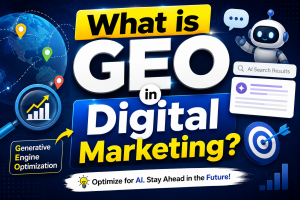
What is GEO in Digital Marketing? Simply put, GEO is the optimization of content for generative AI search experiences.
Traditional search engines generally return a list of webpages. Generative search systems can instead synthesize information from multiple sources and provide a conversational answer.
For example:
Traditional SEO journey:
User → Google → Search results → Website → Information
Generative search journey:
User → AI search → Synthesized answer → Sources/citations → Website
Google’s AI Overviews provide AI-generated snapshots with links to additional information, while ChatGPT Search can provide answers with links to web sources.
This creates a new opportunity for businesses, publishers, educators, and marketers: becoming a useful source that AI systems can discover and reference.
GEO Meaning in Digital Marketing
The GEO meaning in digital marketing is closely connected to content quality, authority, relevance, and machine-readable information.
A GEO-friendly article should make it easy for both humans and AI systems to understand:
- What the topic is
- What question the content answers
- Who created the content
- Whether the information is trustworthy
- What evidence supports important claims
- How different concepts relate to each other
For example, instead of writing a vague paragraph about SEO, a strong article could clearly answer:
What is SEO?
SEO is the practice of improving a website’s visibility in organic search results.
This direct-answer structure can make content easier to understand and extract.
Why Is GEO Important in 2026?
Search behavior is becoming increasingly conversational.
Google has introduced AI Overviews and AI Mode, while ChatGPT provides web search with cited sources. Perplexity also describes itself as an AI-powered search engine that provides conversational answers backed by sources.
Google reported that, in major markets including the U.S. and India, AI Overviews were driving more than a 10% increase in Google usage for the types of queries that trigger AI Overviews.
This matters because users are increasingly asking complete questions rather than typing only short keywords.
For marketers, that means content should answer questions—not simply contain keywords.
GEO vs SEO: What Is the Difference?
| SEO | GEO |
| Search Engine Optimization | Generative Engine Optimization |
| Focuses on search rankings | Focuses on visibility in AI-generated answers |
| Targets search engines | Targets generative AI/search experiences |
| Optimizes for keywords and search intent | Optimizes for questions, entities, context and answerability |
| SERP visibility is important | AI mentions, citations and source visibility are important |
| Traditional search remains central | Conversational and AI search are central |
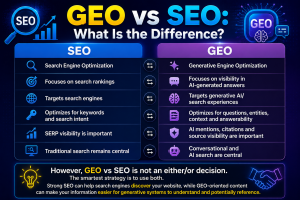
However, GEO vs SEO is not an either/or decision.
The smartest strategy is to use both.
Strong SEO can help search engines discover your website, while GEO-oriented content can make your information easier for generative systems to understand and potentially reference.
How to Optimize Content for GEO
1. Answer the Main Question Immediately
Do not make readers scroll through five paragraphs before getting the answer.
Start with a concise definition.
For example:
GEO stands for Generative Engine Optimization. It is the process of optimizing content for AI-powered search and answer engines.
Then explain the topic in greater detail.
2. Use Question-Based Headings
Use headings such as:
- What is GEO?
- What does GEO stand for?
- Why is GEO important?
- How does GEO work?
- GEO vs SEO: What’s the difference?
This matches conversational searches and makes your content easier to scan.
3. Provide Evidence and Original Information
AI systems need reliable information.
Strengthen your content with:
- Original research
- First-hand experience
- Expert opinions
- Statistics
- Case studies
- Examples
- Author information
- References to credible sources
Do not add statistics simply to make an article look authoritative. Every important statistic should have a credible source.
4. Structure Content Clearly
Use:
- H1, H2 and H3 headings
- Short paragraphs
- Bullet points
- Tables
- Definitions
- Examples
- FAQs
- Step-by-step explanations
Good structure benefits both users and machines.
5. Build Topical Authority
Instead of publishing one article about GEO, create a topic cluster.
For example:
Main topic: Generative Engine Optimization
Supporting articles:
- GEO vs SEO
- How to optimize content for ChatGPT
- AI search optimization strategies
- What is Answer Engine Optimization?
- How AI Overviews affect SEO
- Best GEO tools for marketers
This helps establish depth around a subject.
6. Keep Information Updated
AI search and digital marketing change quickly.
Review important content regularly, especially:
- Statistics
- Platform features
- Search algorithms
- AI tools
- Industry trends
- Course information
A 2024 article can become outdated quickly in an AI-driven search environment.
GEO Example for a Digital Marketing Institute
Imagine a digital marketing institute wants to attract students searching for:
“Best digital marketing course in Noida“
A weak page might only repeat the keyword several times.
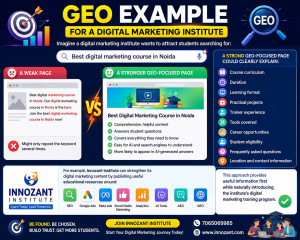
A stronger GEO-focused page could clearly explain:
- Course curriculum
- Duration
- Learning format
- Practical projects
- Trainer experience
- Tools covered
- Career opportunities
- Student eligibility
- Frequently asked questions
- Location and contact information
For example, Innozant Institute can strengthen its digital marketing content by publishing useful educational resources around SEO, Google Ads, Meta Ads, social media marketing, analytics, AI tools, AEO, and GEO—not just promotional course pages.
This approach provides useful information first while naturally introducing the institute’s digital marketing training program.
Practical GEO Checklist for Marketers
Before publishing an article, ask:
- Does the introduction answer the main question?
- Is the primary topic clearly defined?
- Are important questions answered directly?
- Are headings descriptive?
- Is the information factually accurate?
- Are statistics properly sourced?
- Does the article demonstrate expertise?
- Is there original insight or experience?
- Are related topics covered?
- Are FAQs included?
- Is the content easy to quote or summarize?
- Is the article updated regularly?
If the answer is yes to most of these questions, your content has a stronger foundation for both SEO and GEO.
GEO, AEO and SEO: How They Work Together
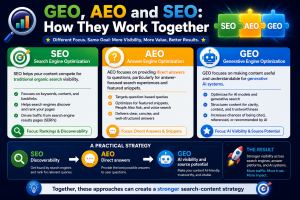
Modern content marketing should not treat SEO, AEO, and GEO as completely separate strategies.
SEO helps your content compete for traditional organic search visibility.
AEO (Answer Engine Optimization) focuses on providing direct answers to questions, particularly for answer-focused search experiences and featured snippets.
GEO (Generative Engine Optimization) focuses on making content useful and understandable for generative AI systems.
A practical strategy is:
SEO → Discoverability
AEO → Direct answers
GEO → AI visibility and source potential
Together, these approaches can create a stronger search-content strategy.
The Future of GEO in Digital Marketing
GEO is still an evolving discipline. There is no guaranteed formula that makes a website appear in every AI answer.
Generative systems can change their retrieval methods, ranking signals, models, and source-selection behavior.
Therefore, marketers should avoid shortcuts such as keyword stuffing, fake statistics, mass-produced low-quality AI content, or manipulating mentions.
The long-term strategy is simpler:
Create genuinely useful, accurate, authoritative, well-structured content.
That principle works for users first—and gives search and AI systems better information to understand.
For digital marketing professionals, learning SEO alone is no longer enough. Understanding search intent, content strategy, AEO, GEO, analytics, paid advertising, and AI tools can provide a more complete skill set.
If you want structured practical training, Innozant Institute offers digital marketing training covering areas such as SEO, paid advertising, social media, and AI-powered digital marketing. Students should evaluate the curriculum, practical projects, trainers, and career support before choosing any institute.
Final Thoughts
The GEO full form in digital marketing is Generative Engine Optimization. It refers to optimizing content so generative AI and AI-powered search systems can understand, evaluate, summarize, and potentially cite your information.
The biggest mistake is thinking GEO vs SEO means one must replace the other. They serve different but increasingly connected purposes.
SEO helps your website compete in traditional search. AEO helps provide direct answers. GEO prepares your content for an increasingly conversational and generative search environment.